
Where do Cave Casualties skills live, and what is PTS?
Open MENU → SKILLS. PTS is the pool on that screen. The notes do not expand the letters. A level-up adds to the pool. XP per level and PTS per level are unpublished.
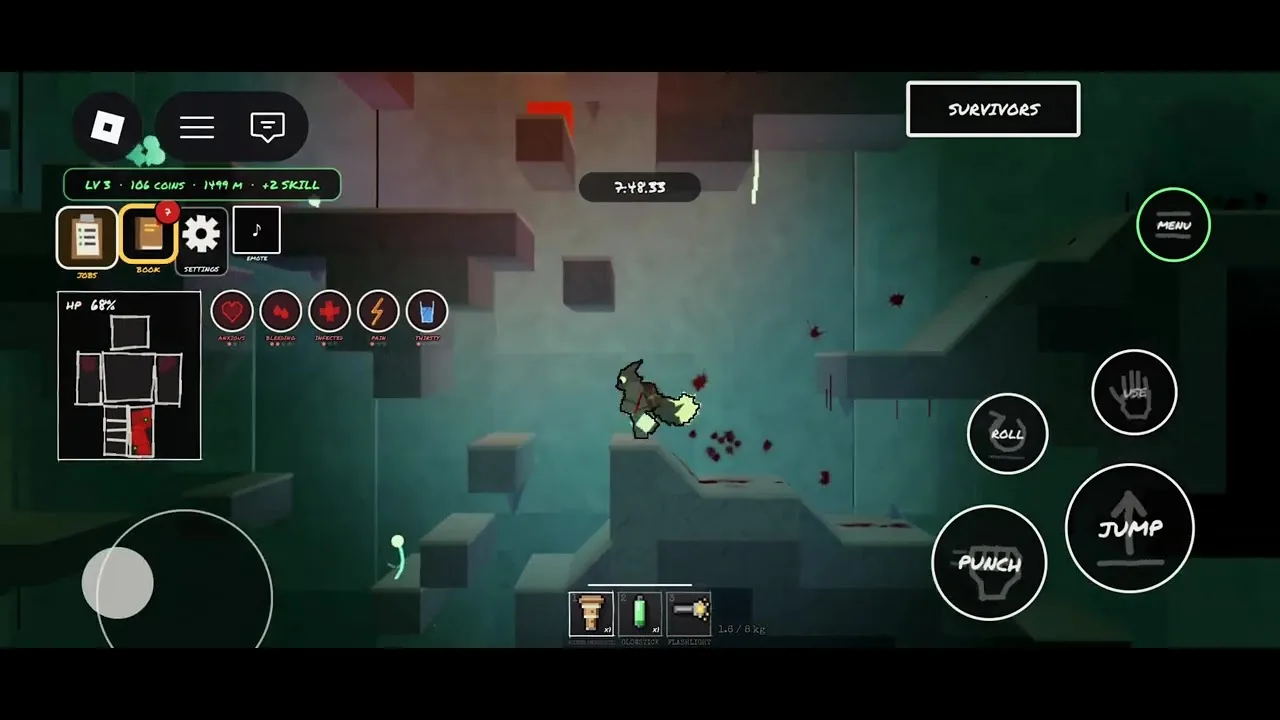
Cave Casualties skills: open MENU then SKILLS, unlock a node, and spend PTS. Caps: Endurance 6, Movement 6, Psychology 4. Strength and Tolerance unpublished.
Endurance, Movement, Psychology, Strength, Tolerance.
~13 min read
Cave Casualties skills are five branches on Place 112611542562333 (Universe 10773485702, Bleedout Interactive). Open MENU → SKILLS to see PTS. Endurance and Movement each stop at 6. Psychology stops at 4. Strength and Tolerance are named, and their caps are unpublished. Checked November 17, 2026. Play on Roblox.
A node is learned after it is unlocked. Select it once to read the effect and the cost. Select it again to spend. A short PTS pool cannot complete that learn. PTS sitting in the pool does not unlock a later node by itself. The notes do not print a PTS price, a node name, or a percent per rank, so this page does not print those either.
The points come from XP, and the published sources are a new depth, a first biome, a first species, a kill, a contract, a searched container, and a daily or playtime task. First biome and first species are claimed in the book. Layer figures and species figures stay on biomes and creatures. Next: the two clicks that actually spend PTS.
| Fact | Detail |
|---|---|
| Screen | MENU → SKILLS |
| Currency | PTS, gained when you level. The label is not expanded in the notes |
| Learn | Unlock the node, select it to read effect and cost, select again to spend |
| Short on PTS | The learn does not go through |
| Later nodes | Stay locked. Holding PTS does not unlock them |
| Endurance | Max 6 · damage reduction and encumbrance |
| Movement | Max 6 · stamina, recovery, speed, and jump |
| Strength | Attack and dig · cap unpublished |
| Psychology | Max 4 · panic and stability |
| Tolerance | Environment and infection spread · cap unpublished |
| XP in | New depth, first biome, first species, kills, contracts, containers, daily or playtime |
| Book claims | BOOK → BIOMES for a first biome. BOOK → SPECIES for a first species |
| Checked | November 17, 2026 |
Matched by build plan, shared topics, and guide progression — not random related links.
The screen is MENU → SKILLS. PTS is the pool on that screen. The notes name the letters and do not expand them, so this page keeps the letters. A level-up is what adds to the pool. How much XP a level takes, and how many PTS that level pays, are unpublished.
Select a node that is already unlocked. The first select shows the effect and the cost. Select the same node again to learn it and spend the cost. Two selects are the published learn. A single glance at the tooltip is the read, and the second press is the spend.
If the pool is smaller than the cost, the learn does not complete. The notes do not say the click is stored for later, and they do not say a partial payment sticks. Come back when the pool covers the cost you just read. Because no cost is printed in the public notes, this page has no PTS column to memorize before you open the menu.
The notes do not publish a first-node order. Early PTS goes to the branch that matches the failure you are already having. A heavy pack and incoming hits point at Endurance. A sprint that dies, a slow cross, or a jump that misses the ledge points at Movement. Weak swings and a slow dig point at Strength. Panic points at Psychology. A cave that worsens you, or an infection that spreads, points at Tolerance. The treatment steps for that infection stay on wounds.
A five-branch plan that buys one rank in everything is a guess. The screen will show a cost when you select a real node. Until that number is in the public notes, this page will not recommend a spread. Next: what each branch is allowed to claim, and where the published max actually stops.
Five names, three published caps. Use the cap as a stop. Use the blank cap as a blank. A branch answers one kind of problem, and the notes do not print a percent for any rank inside it.
| If this is the problem | Branch | Published stop | What the notes tie it to |
|---|---|---|---|
| Hits hurt, or the pack is heavy | Endurance | 6 | Damage reduction and encumbrance |
| Stamina, pace, or a jump fails | Movement | 6 | Stamina, recovery, speed, and jump |
| Swings or digging feel slow | Strength | Unpublished | Attack and dig efficiency |
| Panic is the thing climbing | Psychology | 4 | Panic and stability |
| The cave or an infection is spreading | Tolerance | Unpublished | Environmental worsening and infection spread |
Endurance is damage reduction and encumbrance, max 6. It is the branch for taking hits and for carrying weight. It does not publish a damage formula, so a rank here is not a calculator input. The wound order, including a bleed that sleep will not stop, stays on wounds.
Movement is stamina, recovery, speed, and jump, max 6. The four words are the published direction. A stamina bar length, a speed multiplier, and a jump height in studs are not in the notes. Breath, dry mouth, and the tools that spend stamina on a climb are separate systems. A Flashlight or a Lasso price does not become a Movement rank. Those prices are on items.
Psychology is panic and stability, max 4. The shorter cap is a published stop, and it is not a power ranking against Endurance. The notes do not say rank 4 equals some other branch's rank 6. They say four is the max. A fifth Psychology node is not in the public list, so this page will not tell you to keep buying one.
Anxiety is a status the survival notes already name, and it worsens with depth and danger. Psychology is the branch the skill notes tie to panic. This page does not merge the two into one meter, and it does not claim the November community note rewrote the cap. That note is dated on updates, and it does not include a skill changelog.
Strength is attack and dig efficiency. The cap is unpublished. Digging points at a Pickaxe in the pack, and the booth price of that tool is on the items page. Attack points at whatever you are swinging. A Machete is the weapon named for a mimic fight, and the mimic tell itself is on mimics. Strength does not publish a damage number for either tool, so a rank here still is not a damage-per-swing.
Tolerance is environmental worsening and infection spread. The cap is unpublished. Do not copy 6 from Endurance or 4 from Psychology into this cell. Infection treatment is still antibiotics or a disinfectant, then a cut when the notes call the tissue rot. Tolerance is the spread side of that problem. It does not replace the prompt on the part. The Frost, the geysers, and the green water have their own rules on biomes. A Tolerance rank is not a printed substitute for a coat, a soak, or leaving the green water alone. Next: why a full PTS pool still leaves the next node locked.
Unlock and learn are two steps. PTS pays the learn. PTS does not perform the unlock. A later node that is still locked stays locked while the points sit in the pool.
The notes are explicit on this point: a later node that has not been unlocked does not open because you are holding skill points. Saving PTS for a node you cannot select yet does not flip that node. Unlock it first. Then do the two selects and spend.
What performs the unlock is the gap. The notes do not name a second button, a level number, or a "buy the previous rank" rule. This page will not add one. If the node will not select, the learn clicks do not apply to it yet. Go earn the condition the screen is actually waiting on, and read that condition in the menu rather than from a guessed order of 1 through 6.
Endurance ends at 6. Movement ends at 6. Psychology ends at 4. Past those numbers there is no published node to unlock, so extra PTS cannot open one. Strength and Tolerance do not have that sentence. Treating them as max 6 because the neighbors stop at 6 invents a cap. Treating them as endless because the cell is blank invents the other direction. The honest line is that the stop is unpublished, and the menu is where the last selectable node will show.
A short pool still blocks the learn after the node is unlocked. Unlock gets you to the cost. The cost has to fit. Those two failures feel similar in a menu and they are different fixes: one needs the unlock, the other needs more PTS. Next: the actions that actually put XP on the account before a level pays points.
A level is what pays PTS. These are the XP sources the notes list. Amounts that already have a home on another page stay there. Amounts the notes never printed stay blank here too.
| Source | What is published | Where the figure lives |
|---|---|---|
| New depth | Reaching a new cave layer pays arrival XP | Layer numbers are on the biomes page |
| First biome | Claim the first find in the book | BOOK → BIOMES |
| First species | Claim the first find in the book | BOOK → SPECIES |
| Kill | A kill pays the kill column, separate from discovery | Creature rows |
| Contract | Open JOBS, do the objective, return, CLAIM, wait for PAID | One example below |
| Container | Searching a container is listed as XP | No per-container amount |
| Daily or playtime | Listed as XP sources | No PTS figure on the gift items |
A first biome is claimed in BOOK → BIOMES. A first species is claimed in BOOK → SPECIES. The notes treat that claim as the first-find payout. Seeing the same biome or the same species again does not repeat it. An unclaimed book line is a payout you have not taken yet.
Kill XP is the other number. It is paid for the kill, and it is not the book click. The creature page keeps those pairs. This page only needs the split: the book is the first find, the kill is the kill, and neither one is a skill rank. A layer arrival, such as the early stops under the lobby, is a third number and lives with the biomes.
Contracts start in JOBS before you drop. Read the objective, the progress, and the coin and XP reward. Finish it on the way down, return to JOBS, and press CLAIM. PAID means the reward was taken. The one example the notes price is Get Out Alive: one Rescue Capsule extract, 220 coins and 400 XP. That 400 is contract XP. It is not a species discovery and it is not a skill rank.
Other contract names and rewards are not in the notes, so they are not invented here to fill a ladder. Searching a container is on the XP list with no amount beside it. Daily login and playtime tasks are on the list too. The gift items those tracks are known for, such as a bandage or water, are described on items, and those item lines do not include an XP or PTS number. Do not add one so the row looks finished. Next: the cells this page is leaving empty on purpose.
A guide can pressure a page into filling every header. These headers were suggested by the shape of a skill tree, and the notes left them empty. Empty is the published state.
| Cell | Why it stays empty |
|---|---|
| PTS cost per node | The menu shows a cost on select. No public list of those costs |
| Percent per rank | Branches name a direction. They do not name a bonus number |
| XP per level | Level-up grants PTS. The XP threshold is unpublished |
| PTS per level | The grant exists. The count per level does not |
| Strength cap | Attack and dig are named. A max rank is not |
| Tolerance cap | Spread and environment are named. A max rank is not |
| Node names | No public list of individual node titles |
| Unlock button | Later nodes stay locked without PTS doing it. The unlock control is unnamed |
| Best first branch | No ranked order. Match the problem you are already hitting |
If a cost cell were filled with 0, the learn would look free. The notes say a short pool blocks the learn, which means costs exist and are simply not listed outside the menu. Read them on the first select. If a Strength or Tolerance cap were filled with 6, two branches would inherit a stop that was printed only for Endurance and Movement. Leave the stop on the branches that have one.
Individual node titles would let a route say "buy this named rank." The notes never supply the titles. Routes on this page stay at the branch: the direction, the max when one exists, and the unlock-then-learn order. A damage calculator that asks for a Strength rank is the same kind of invention. There is no published attack formula to multiply.
The branch names stay plain text. Official art on this site is the Roblox game-pass set. Those pictures are a rope, a pickaxe pass, a starter pack, a lift, a private server, and VIP. None of them is an Endurance node or a Psychology node. A pass icon on a skill row would be the wrong object.
The clip used on other pages of this site does not show MENU → SKILLS. A dark cave, a subtitle, or a get-dry line is not a skill tree, so it is not pasted here as proof of a node. When a real tree capture exists, the table can take it. Until then the row is the name, the stop, and the direction. Next: take the first unlocked node onto a dive, and keep the wound prompts in their own order.
The first pack, the lift, and the leave-or-depth choice are on the beginner guide. Bleeds, infection treatment, and why sleep leaves both running are on wounds. Booth prices for the dig tool and the medical supplies are on items. Dated notes, including the community Psychosis line that does not rewrite these caps, are on updates.
Open MENU → SKILLS. PTS is the pool on that screen. The notes do not expand the letters. A level-up adds to the pool. XP per level and PTS per level are unpublished.
Unlock it first. Select it to read the effect and the cost. Select it again to spend PTS. If the pool is short, the learn does not complete. Holding PTS does not unlock a later node.
Endurance 6, Movement 6, Psychology 4. Strength and Tolerance are named, and their caps are unpublished. Do not copy 6 or 4 onto those two.
Endurance is damage reduction and encumbrance. Movement is stamina, recovery, speed, and jump. Strength is attack and dig. Psychology is panic and stability. Tolerance is environmental worsening and infection spread. No percent per rank is published.
A new depth, a first biome in BOOK → BIOMES, a first species in BOOK → SPECIES, kills, contracts, searched containers, and daily or playtime tasks. Get Out Alive is the priced contract example: 220 coins and 400 XP for one Rescue Capsule extract.
Matched by build plan, shared topics, and guide progression — not random related links.